Starting IVF treatment can feel overwhelming when you are unsure about what happens at each stage. Understanding the journey from the first consultation to embryo transfer can help couples feel more prepared and confident about the treatment process.
If you are looking for an IVF Doctor in Bangalore, Dr. Jyoti Bandi can help you understand your fertility concerns, explain suitable treatment options, and guide you through the different stages of IVF based on your individual needs.
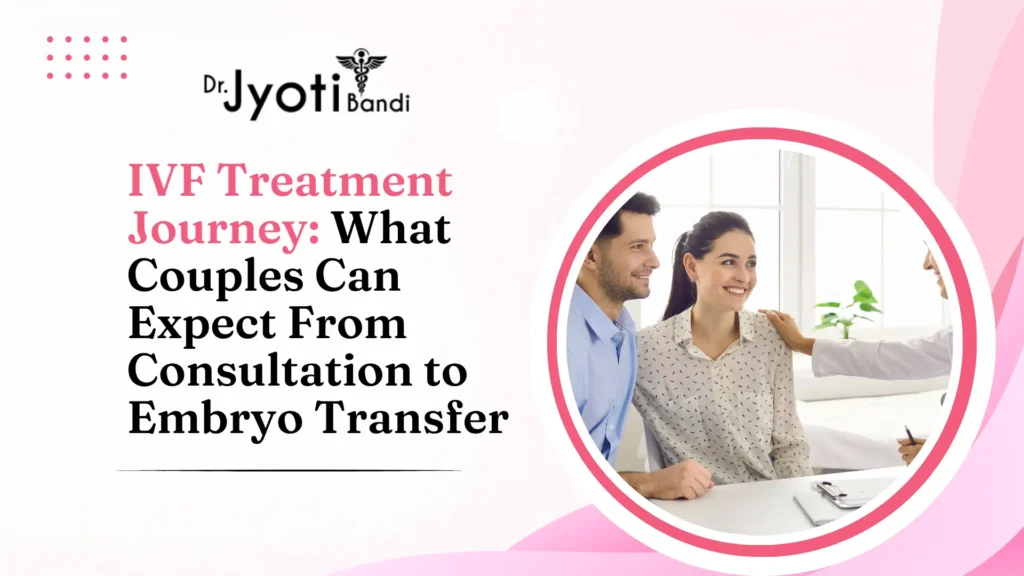
The IVF journey usually begins with a detailed consultation. Your doctor will review your medical and fertility history, previous pregnancies, menstrual cycles, previous treatments, and any relevant health conditions. Both partners may undergo appropriate evaluation because fertility challenges can involve female, male, or combined factors. Previous reports, scans, semen analysis, or fertility treatment records can also help your doctor understand your situation.
Step 2: Fertility Assessment and Treatment Planning
Before starting IVF, your fertility specialist may recommend investigations to assess ovarian reserve, ovulation, reproductive anatomy, and sperm health. The results help determine whether IVF is appropriate and which treatment approach may be most suitable. Your doctor can also explain the expected timeline, medications, procedures, possible risks, and factors that may influence treatment outcomes.
Step 3: Ovarian Stimulation
Once the treatment plan is established, medications are prescribed to stimulate the ovaries and encourage the development of multiple follicles. Normally, one dominant follicle develops during a menstrual cycle. During IVF, ovarian stimulation aims to produce multiple mature eggs that can potentially be retrieved and fertilised. The medication and duration vary according to individual factors.
Step 4: Monitoring Follicle Development
During ovarian stimulation, regular ultrasound scans and, when required, blood tests are used to monitor follicle growth and hormone levels. Your doctor may adjust medication doses depending on how your ovaries respond. Monitoring is important because it helps determine when the follicles are ready for egg retrieval.
Step 5: Trigger Injection and Egg Retrieval
Once the follicles reach the appropriate stage, a trigger injection is given to support final egg maturation. Egg retrieval is then scheduled at the appropriate time. The procedure is performed under sedation, with the eggs collected from the ovaries using ultrasound guidance. The retrieved eggs are transferred to the embryology laboratory for assessment.
Step 6: Fertilisation and Embryo Development
After retrieval, mature eggs are fertilised with sperm in the laboratory. Depending on the circumstances, conventional fertilisation or ICSI may be considered. The resulting embryos are monitored as they develop over the following days. The embryology team assesses embryo development before determining which embryos may be suitable for transfer or freezing.
Step 7: Embryo Transfer
Embryo transfer involves placing a selected embryo into the uterus using a thin catheter. It is generally a relatively short procedure and does not usually require anaesthesia. Your fertility specialist will explain the timing of transfer and any medications required around the procedure.
Following embryo transfer, you may be advised to continue prescribed medications and follow your clinic’s instructions. Pregnancy testing is usually performed after an appropriate interval rather than immediately after transfer. Your doctor will tell you when to take the test and how the next steps will be managed. It is important to remember that IVF does not guarantee pregnancy. Outcomes can vary depending on age, ovarian reserve, sperm factors, embryo quality, and other individual circumstances.
At DYU Healthcare, IVF treatment is planned around the individual fertility needs of each couple. From the initial consultation and fertility assessment to ovarian stimulation, egg retrieval, embryo development, and transfer, the fertility team provides guidance throughout the different stages of treatment.
The timeline varies between couples. Some stages may be completed within one menstrual cycle, while others may require additional preparation, testing, or frozen embryo transfer in a later cycle. Your fertility specialist can provide a more personalised timeline after reviewing your medical history and treatment plan.
Conclusion
The IVF treatment journey involves several carefully planned stages, from the initial fertility consultation and assessment to ovarian stimulation, egg retrieval, fertilisation, embryo development, and embryo transfer.
Understanding each step can help couples approach treatment with realistic expectations and greater confidence. If you are considering IVF and looking for an IVF Doctor in Bangalore, Dr. Jyoti Bandi can guide you through the treatment journey and help you understand the options most appropriate for your fertility needs.
FAQ’s
IVF usually begins with a fertility consultation, medical history review, appropriate investigations, and personalised treatment planning.
Ovarian stimulation commonly lasts around 8–14 days, although the exact duration varies depending on individual response and treatment protocol.
Egg retrieval is generally performed under sedation to minimise discomfort. Mild cramping or bloating may occur after the procedure.
Retrieved eggs are assessed in the laboratory, fertilised with sperm, and resulting embryos are monitored during their development.
A selected embryo is placed into the uterus using a thin catheter through the cervix during a relatively short procedure.